Most of the signs we make are printed signs. Not illuminated letters, not neon — printed panels, banners and vinyl. That surprises people who assume a sign shop is mostly about light, but it is the plain arithmetic of a working town: a restaurant needs a menu board this week, a developer needs a hoarding around a site for eight months, a hotel needs its reception wall finished before the first guests arrive in December.

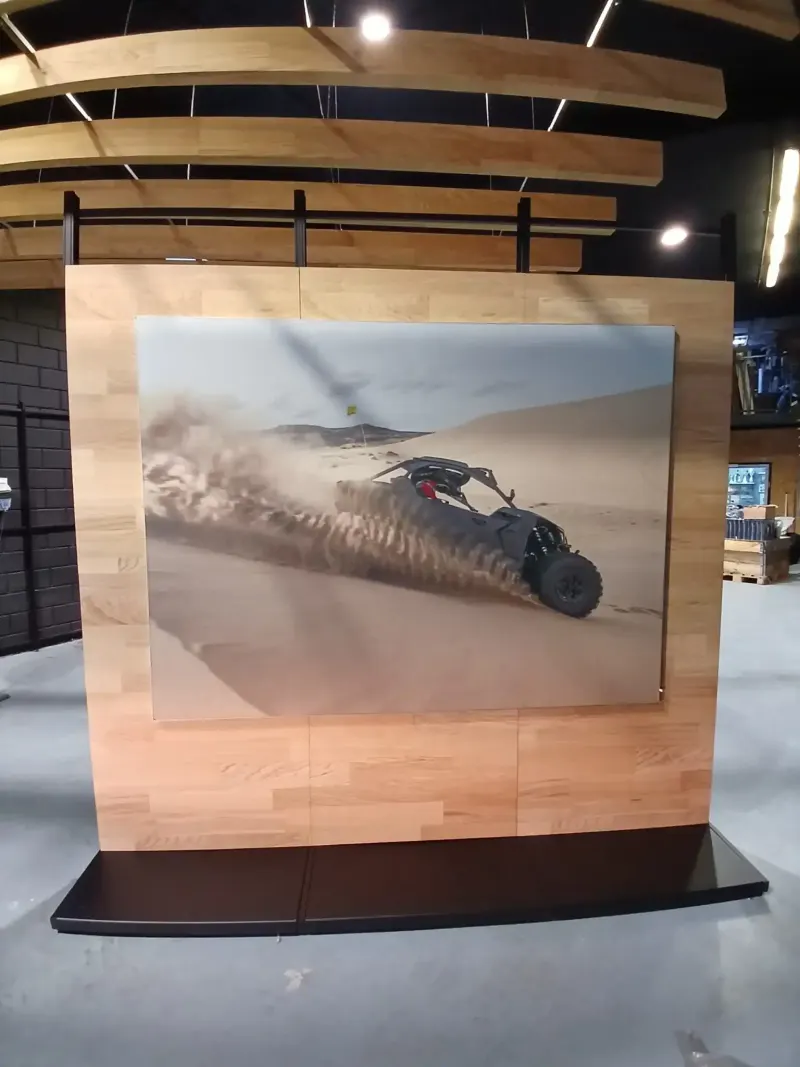
And almost every decision about a printed sign turns out not to be a decision about the printing at all. The press does roughly the same thing every time. What changes is what the ink lands on, and how long that material stays flat, bright and attached to the building. This guide is the decision, laid out in the order it actually gets made.
Four Materials, and What Each One Is Actually For
There are four substrates in ordinary use here. A print shop that offers you only one of them is selling you what it stocks, not what your sign needs.
1. Flexible Vinyl — the Banner
Flexible PVC vinyl is the material a banner is made of. It rolls up, it travels in the back of a car, and it can be hung between two poles, lashed to a fence or stretched across a scaffold in an afternoon. It is, by a distance, the cheapest way there is to put a large message somewhere specific for a specific period. It is also the shortest-lived of the four, and it is meant to be. If you want the full specification — hems, grommets, pole pockets, mesh for wind — the guide to banner printing goes through it properly.
2. PVC Board — the Rigid Panel That Belongs Indoors
PVC board, which everyone calls Sintra regardless of who made it, is a light rigid sheet that prints beautifully. Menu boards, directional signs inside a building, price panels, exhibition graphics, real-estate boards. It costs a little more than a banner and gives you a rigid panel instead of fabric. The honest limitation is direct sun: in full tropical exposure a PVC panel has two to three years in it before it starts to look tired, and no coating changes that. There is a whole guide to where PVC board signs belong and where they quietly fail.
3. ACM Panel — the One That Stays Outside
Aluminium composite is two thin aluminium skins bonded to a plastic core. It does not rust, it does not swell, and it does not warp, because the aluminium blocks the sun from ever reaching the core. That is why it ends up on storefront fascias, monument signs and the backing panels behind illuminated letters. It costs several times what a banner costs, and the right thing to compare that against is seven years of not replacing anything. Our guide to Lokbond ACM panels covers thicknesses and routing.
4. Adhesive Vinyl — the Substrate You Already Own
Adhesive vinyl is the odd one out, because it has no substrate of its own. It borrows one. A window, a wall, a tiled floor, the door of a van. Cast vinyl with a protective laminate is what makes that work over curves and in sun; the cheap film is what curls at the corners by March. Contour-cut work costs more than a straight rectangle, because the cutter has to follow the shape. Vinyl is also the fastest thing we make — 24 hours is normal. Which film to ask for, and how it behaves inland versus on the water, is in the guide to adhesive vinyl across Guanacaste.
Two Ways to Get Ink Onto a Sign
Once the material is chosen there is a second, quieter decision, and most customers never hear it discussed. The ink can go onto the panel directly, or it can go onto a film that is then stuck to the panel.
Direct UV printing puts the ink straight onto the rigid surface and cures it instantly under ultraviolet light, so it bonds to the panel rather than sitting on an intermediate layer. There is nothing to peel, nothing to bubble at the edges, and no seam where humidity can get in. Our flatbed handles up to three metres by two metres in one piece. If you want the technique itself rather than the materials, the article on direct UV printing is the one to read.
Print-and-mount is the older route: print onto adhesive vinyl, laminate it, then apply it to a board. It is still the right answer sometimes — a curved surface, a very short run, a graphic that has to be changed next season on the same panel. But in a humid coastal climate, every edge of an applied film is a place where the sign can start to come apart, and that is the reason we print direct wherever the job allows it.
What the Coast Actually Does to a Printed Sign
Here is the part that gets left out of most material comparisons, because it is local and unflattering. Salt air destroys unsuitable materials in months, not years. That is not a figure of speech — it is why every sign we build for a beach town gets anti-corrosion treatment and sealed electrical connections as standard rather than as an upgrade.
Printed signage fails in a few recognisable ways here. A west-facing panel fades on one side first, because in Guanacaste the afternoon sun is the whole story and a wall that catches it from two o'clock takes several times the dose of a wall that does not. Banner edges go first, always, because the wind works the grommets. Panel edges are the second failure: where an exposed core can take up water in the green season, it does, and the face lifts. And inland is genuinely different from the beach — the same panel that is fine in Santa Cruz can chalk within two seasons on a fascia four hundred metres from the surf.

None of this is a reason to buy the most expensive material every time. It is a reason to match the material to how long the sign has to live. A banner for a December tournament does not need to survive to March. A fascia does.
What a Printed Sign Costs
Four things move the number, in roughly this order: the finished size, the material, the finishing, and whether our team installs it. The formats also rank against each other in a fixed order, and that ranking is more useful than any single figure — a vinyl banner is the cheapest way to say something large, adhesive vinyl sits beside it, PVC board costs more and buys a rigid panel, a roll-up costs more again because it arrives with its own stand, and ACM is the most expensive because it is the only one built to stay outside for years.
We keep the actual figures in one place instead of scattering them through articles that age: the cost guide carries the current entry price for every format. For your own sign, the advisor is faster and more honest than a table — tell it the size and the material and it prices that sign, not a starting point for someone else's.
Everything we build carries a six-month warranty, external damage excluded. Near the sea we say plainly that there is no guaranteed lifespan on a specific material: salt, humidity and sun will eventually mark anything, and a supplier who promises otherwise is promising something they cannot control.
Price Your Own Sign
answers in secondsNo two signs cost the same — size, material, finishing and installation each move the number. Tell Worky what you need and it prices your sign, not an average.
Worky is an AI. Answers may contain errors — always verify with us.
How Fast
Printed work is the fast half of this business, which is exactly why people reach for it. Stickers and vinyl are ready in 24 hours. UV printing on panels takes 24 to 48. A simple illuminated sign is about three days and a standard one about a week, so when someone needs something for Saturday the answer is usually a printed panel or a banner — sometimes as the temporary sign while the permanent one is being built. Larger or more complex jobs run up to two weeks.
Deciding, in Four Questions
How long does it have to live? Under a year outdoors: banner. One to three years, out of direct sun: PVC. Permanent and exposed: ACM.Is it flat, and is it yours? If the surface already exists and belongs to you — window, wall, vehicle — you may not need a panel at all, just vinyl.How far away will it be read from? This decides size before it decides material, and size drives the price more than the substrate does.Who installs it? A panel is a sign; a panel on a wall at four metres is a job. Deciding that early is what keeps the quote from moving.
Before You Ask for a Price
A printed sign needs two things before an estimate can exist: the size, and the material. Everything else can be worked out in conversation, but without those two any number is a guess. If you already know roughly where it goes and how long it needs to last, we can usually pick the material for you in one message. Choosing who makes it is a separate question from choosing what it is made of, and the guide to hiring a sign company covers what to ask before committing.
Bring the artwork if you have it, and bring it as a vector file or as the largest original you own. A logo lifted from a website is about a thousand pixels wide, and a thousand pixels stretched across two metres of panel looks exactly like what it is. If that is all that exists, say so early — redrawing a mark cleanly is routine work, but it is not something to discover on the morning of the install.
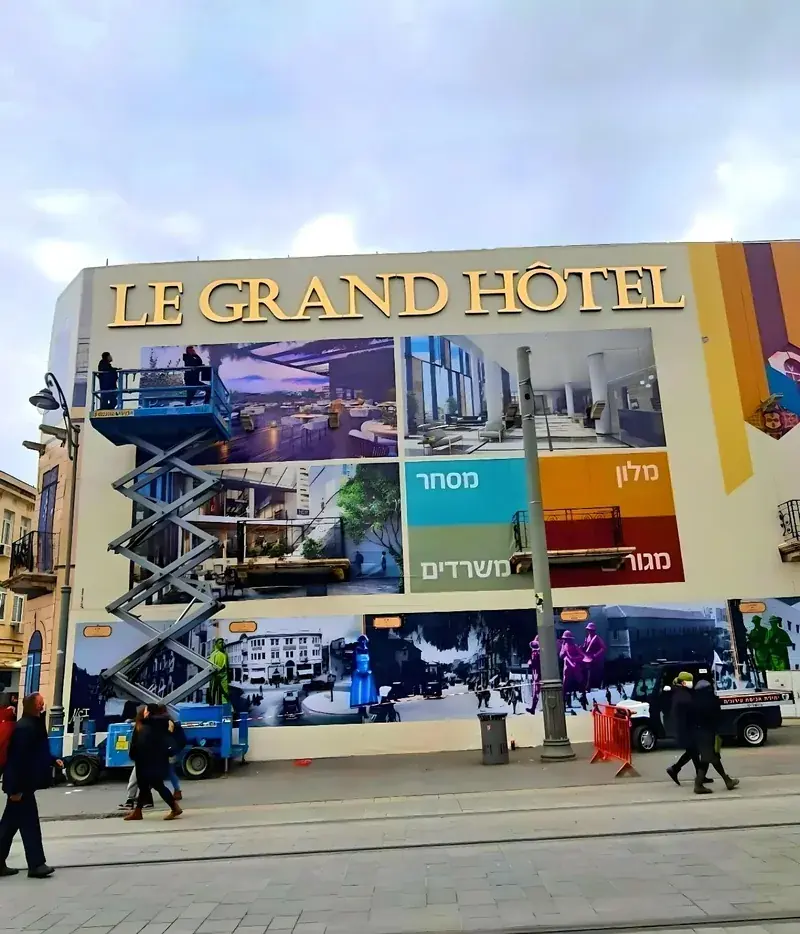
Printed signage is also not a separate world from the rest of the catalogue. The same flatbed that prints a menu board prints the backing panel behind a set of illuminated letters, and a project often uses both. For jobs at facade scale — wraps, multi-panel joins, work at height — the companion guide to large format printing picks up where this one stops.
And if the sign is going up in a beach town, it is worth reading how the same materials behave a hundred metres from the water: the notes on vinyl and stickers in Tamarindo are written from that specific, unforgiving address.
